|
|
Always wear safety glasses when operating machine tools. |
|
Download PDF 1075 Instructions
|
Back to 4-Jaw Self Centering Chucks
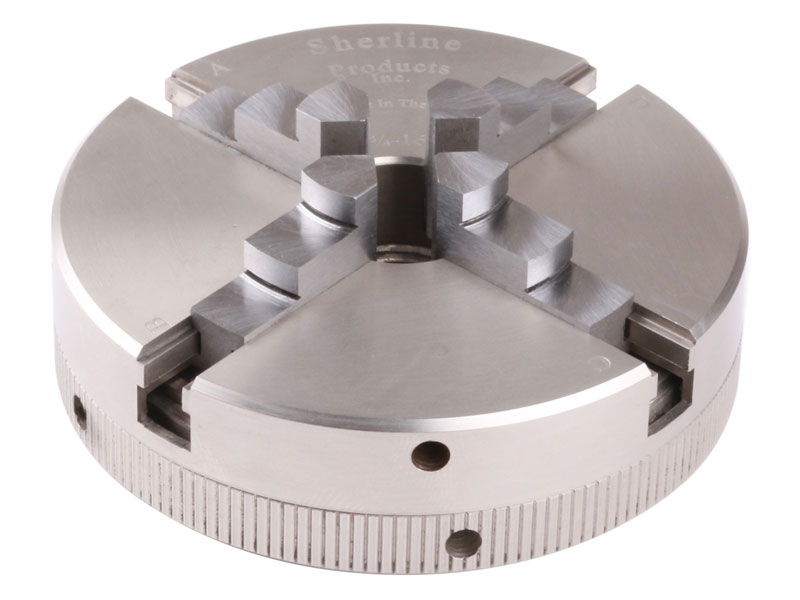
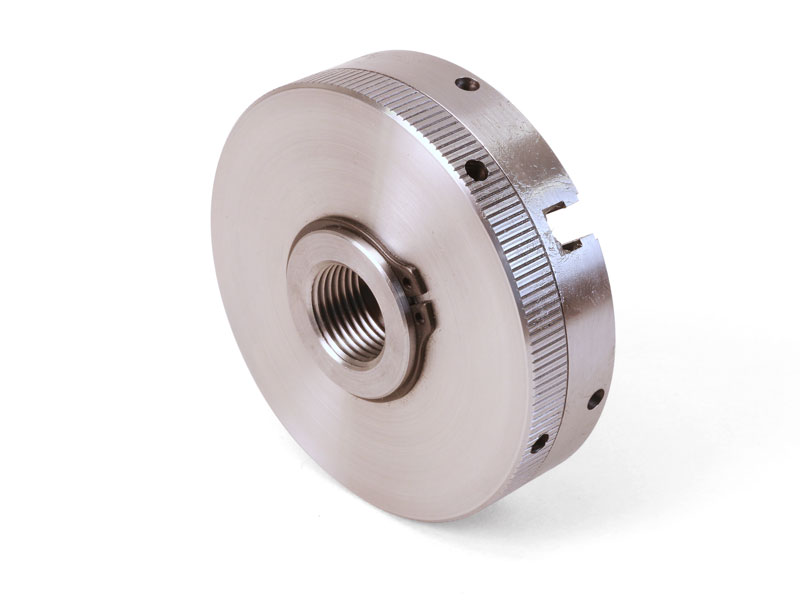
Image shown is a representation only. Actual product may vary.
3.1″ 4-Jaw Chuck – Electroless Nickel Coated
This chuck is identical to P/N 1076 except for an Electroless Nickel coating that has been applied to help prevent wear and corrosion. This special coating has been applied to all external and internal surfaces of the chuck (except for chuck jaws), significantly improving the life of the chuck. This chuck also opens and closes more smoothly due to the lubrication properties of Nickel-Teflon.
- Ductile plating with columnar structure
- Harder than any other nickel-based coating
- Coating uniformity that eliminates post-plate grinding (or burnishing)
- Wear properties overall superior to hard chromium
- Hardness (68-72 Rc)
- Low coefficient of friction (.044) Teflon™ is .04
- Uniform coating thickness up to .004”
- Accepts dry film lubricants
Jaw Options
- For those who have jobs where speed and ease of use are more important than maximum accuracy and want a chuck that is loose right from the start (No extra charge).
Add the note “loose jaws” to the comments box below - Soft (not hardened or machined) steel jaws are also available when you build your own chuck.
How to Distinguish between Standard Chucks and Coated Chucks
Some of our customers have been wondering how to tell the difference between our standard chucks and those that have the Electroless Nickel coating. Standard chucks have darker markings than the coated chucks (See Figure 1. Click on photo to view a larger image).
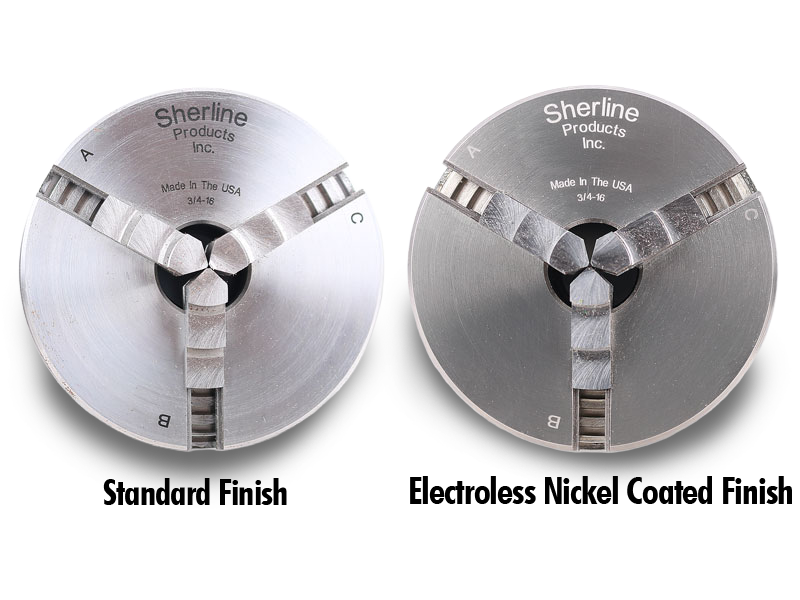
Here, at Sherline Products, each of our chucks is laser engraved with a company mark, chuck size, and jaw location. During the laser marking process the laser removes a bit of the surface and darkens the material below (Figure 1, left). When chucks are sent out to receive the Nickel-Teflon finish the coating process changes the dark engraved markings to a noticeably lighter finish (Figure 1, right).
There is also a subtle change in the color of the chuck, but in the absence of being able to compare them side by side, the most evident way to tell whether you have a coated chuck, or not, is to check the color of the laser markings.
-



| Chuck Diameter | 3.1″ |
|---|---|
| Jaw Capacity | With jaws in normal position: 3/32″ (2mm) – 1-1/2″ (38mm)
With jaws in reverse position: 5/16″ (8mm) – 2-3/4″ (70mm) |
| Through Hole Diameter | .687″ (17mm) |
| Thread Size | 3/4-16 |
| Chuck Body Material | 12L14 Steel |
| Chuck Jaws Material | 12L14 Case Hardened Steel |
| Coating (#1076C only) | Electroless Nickel-Teflon (#1076C only) |
| Part No. | Description | Quantity |
|---|---|---|
| 10761C | 3.1″ 4 Jaw Chuck Body 3/4-16 Thread Electroless Nickel-Teflon Coated | 1 |
| 10402C | 3.1″ Chuck Scroll Electroless Nickel-Teflon Coated | 1 |
| 10413 | Chuck Retainer Ring | 1 |
| 11771 | 4 Jaw Chuck Jaw – Self Centering* | 4 |
| 40580 | Tommy Bar | 2 |
*Because chuck jaws are factory ground to precisely match each chuck body you must send your chuck back to us to be fitted with new jaws. Please contact us for instructions on how to return your chuck.
Click the P/N below to download a zipped version of the IGS 3D CAD file. You will need to extract the zip file before viewing the IGS file.
1076 4-Jaw Chuck 3D IGS model
You need an IGS viewer to view .igs files. CLICK HERE to download a FREE IGS viewer.
Related products
- They can be used to hold irregularly shaped parts.
- They can be used to center parts with a great deal of accuracy.
- 4-jaw chucks can be used to deliberately hold a part off-center.
- They can clamp stock tighter.
- For those who have jobs where speed and ease of use are more important than maximum accuracy and want a chuck that is loose right from the start (No extra charge). Add the note “loose jaws” to the comments box below
- Soft (not hardened or machined) steel jaws are also available when you build your own chuck.
- Ductile plating with columnar structure
- Harder than any other nickel-based coating
- Coating uniformity that eliminates post-plate grinding (or burnishing)
- Wear properties overall superior to hard chromium
- Hardness (68-72 Rc)
- Low coefficient of friction (.044) Teflon™ is .04
- Uniform coating thickness up to .004”
- Accepts dry film lubricants
- For those who have jobs where speed and ease of use are more important than maximum accuracy and want a chuck that is loose right from the start (No extra charge). Add the note “loose jaws” to the comments box below
- Soft (not hardened or machined) steel jaws are also available when you build your own chuck.
- 1 1/4" x 1" steel dowel pin that is used to adjust the jaws during installation and to chuck up on while boring and turning the jaws
- 1 1/8" hex key for tightening the 4-40 x 3/8" jaw mounting screws
- 2 spindle or "Tommy" bars for loosening and tightening the chuck
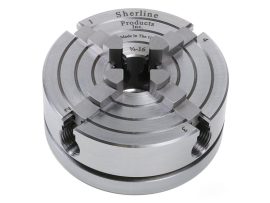
3.1″ 4-Jaw Independent Chuck – 3/4-16 Thread
Includes hex key, not pictured
These chucks have four advantages over 3-jaw chucks.
This is a valuable asset when machining cams, crankshafts and similar parts. The main disadvantage of the 4-jaw independent chuck is that the jaws must be set individually, adding considerable setup time. The jaws are reversible to accommodate larger stock.
NOTE: The independent chucks don't have Tommy bar holes like the scroll chucks because most people use the 5/32" hex wrench into one of the jaw screws to thread the chuck on and off. Our P/N 3020 5/32" Hex T-Driver works perfectly.Like the Sherline 3-jaw chucks, the 4-jaw chucks can be used to clamp either externally or internally. Although we recommend the 3-jaw chuck for standard lathe projects, the 4-jaw chuck is considered the accessory that could add the most versatility to your machine. A clamping groove allows the chuck to hold parts for milling.
Jaw Options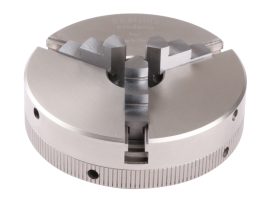
3.1″ 3-Jaw Chuck – Electroless Nickel Coated
This chuck is identical to P/N 1040 except for an electroless Nickel coating that has been applied to help prevent wear and corrosion. This special coating has been applied to all external and internal surfaces of the chuck (except for chuck jaws), significantly improving the life of the chuck. This chuck also opens and closes more smoothly due to the lubrication properties of Nickel-Teflon.
Some of our customers have been wondering how to tell the difference between our standard chucks and those that have the electroless Nickel coating. Standard chucks have darker markings than the coated chucks (See Figure 1. Click on photo to view a larger image).
[caption id="attachment_4231" align="aligncenter" width="300"] Figure 1—Examples: (Left) 1040 3-Jaw Chuck (3.1″), (Right) 1040C Electroless Nickel Coated 3-Jaw Chuck (3.1″).[/caption]
Here, at Sherline Products, each of our chucks is laser engraved with a company mark, chuck size, and jaw location. During the laser marking process the laser removes a bit of the surface and darkens the material below (Figure 1, left). When chucks are sent out to receive the Nickel-Teflon finish the coating process changes the dark engraved markings to a noticeably lighter finish (Figure 1, right).
There is also a subtle change in the color of the chuck, but in the absence of being able to compare them side by side, the most evident way to tell whether you have a coated chuck, or not, is to check the color of the laser markings.
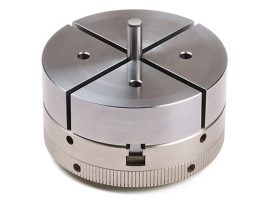
3.1″ 4-Jaw Chuck with Pie Jaws
Includes a steel dowel pin, hex key, and 2 tommy bars, not pictured.
This chuck features a Electroless Nickel coated chuck body for durability and rust resistance.
Included with the chuck and jaws:Because the jaws are meant to be bored to size for particular jobs, eventually they will need to be replaced. The replacement set P/N 1143-4P can be installed on your existing 1076C Electroless Nickel coated chuck body and master jaws. They are NOT intended for use on the standard 1076 chuck body.
NOTE: These jaws are designed to be used ONLY on our Electroless Nickel coated chuck P/N 1076C, and master jaws are custom fitted to each body, so master jaws (11445-P) are not available for purchase separately.
Why pie-shaped jaws?First developed by watch and clock makers, chucks with pie-shaped jaws offer two main advantages. Boring the unhardened jaws to hold a particular diameter part means that instead of gripping the part at only three or four tiny contact points, they grip the part all the way around its diameter. This increased gripping area allows for much less clamping pressure and less chance of deforming a gear or other delicate part held in the chuck. In addition, because the face is bored to an exact and consistent depth, placing additional parts in the chuck for turning or milling means each part surface is held at exactly the same depth as the previous parts, saving setup time.
Use on ornamental turning lathesWe decided to make pie jaws for our four-jaw self-centering chuck after a request by David Lindow, the owner of Lindow Machine Works, Maker of Modern Rose Engine Lathes, (https://lindowmachineworks.com/lindow-rose-engine-menu/). Ornamental turners need a chuck that can firmly grip wooden stock without damaging the surface. In addition to David’s request, we had also received several requests from our horological customers who were looking for a chuck similar to the Swiss-made watchmaker's scroll chuck. We designed our pie jaws in both form and function after the Swiss chucks.
How to Distinguish between Standard Chucks and Coated ChucksSome of our customers have been wondering how to tell the difference between our standard chucks and those that have the Electroless Nickel coating. Standard chucks have darker markings than the coated chucks (See Figure 1. Click on photo to view a larger image).
[caption id="attachment_4231" align="aligncenter" width="300"] Figure 1—Examples: (Left) 1040 3-Jaw Chuck (3.1″), (Right) 1040C Electroless Nickel Coated 3-Jaw Chuck (3.1″).[/caption]
Here, at Sherline Products, each of our chucks is laser engraved with a company mark, chuck size, and jaw location. During the laser marking process the laser removes a bit of the surface and darkens the material below (Figure 1, left). When chucks are sent out to receive the Nickel-Teflon finish the coating process changes the dark engraved markings to a noticeably lighter finish (Figure 1, right).
There is also a subtle change in the color of the chuck, but in the absence of being able to compare them side by side, the most evident way to tell whether you have a coated chuck, or not, is to check the color of the laser markings.
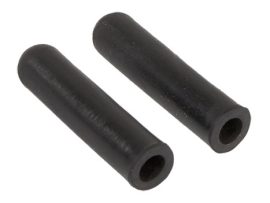
Spindle Bar Grips
Spindle “Tommy” bars can be hard on your fingers when tightening or loosening a chuck, or removing a tool from the spindle. These molded rubber end caps give a more comfortable and secure grip. They also prevent spindle bars from rolling off your bench. Spindle bars and rubber covers can also be purchased as a pair as P/N 4059.